
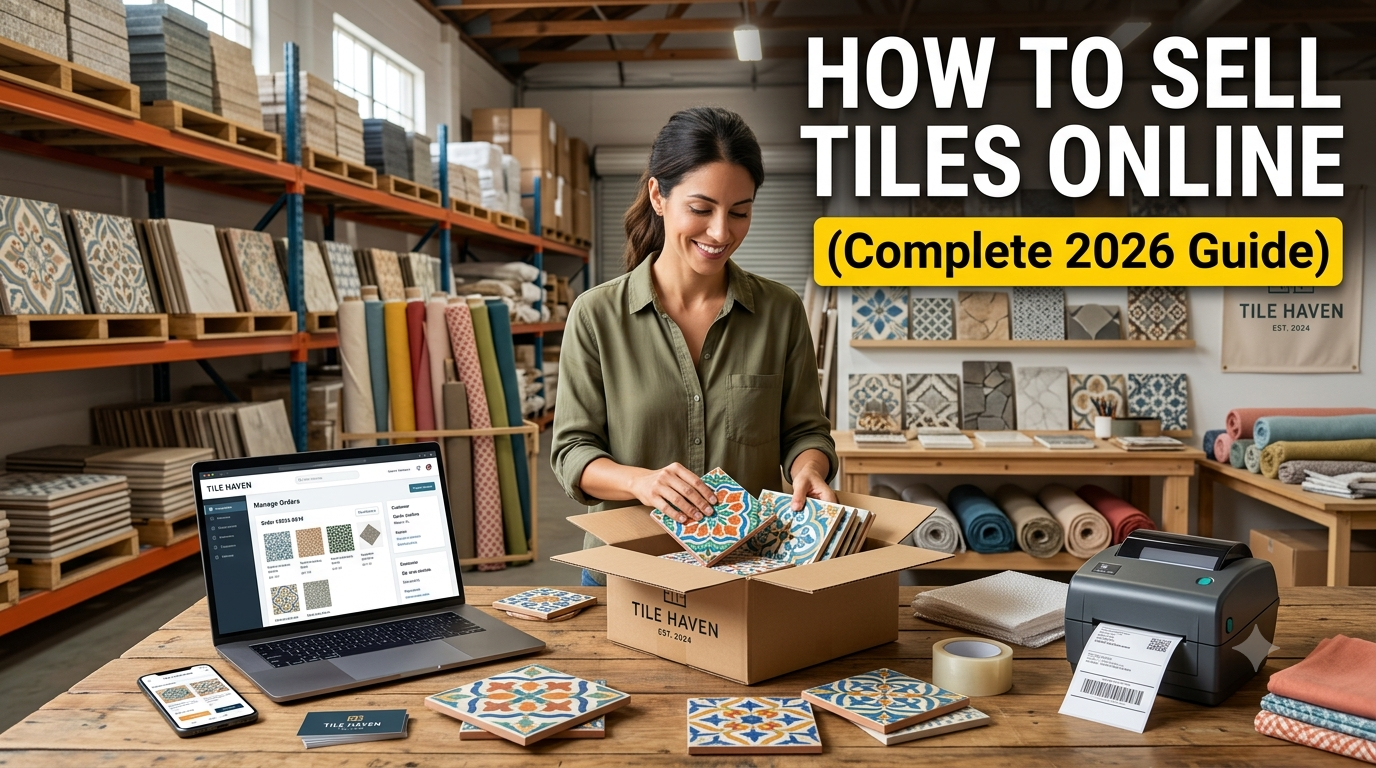
Whether you’re selling ceramic wall tiles, porcelain floor tiles, natural stone, mosaics or outdoor paving, more customers now begin their buying journey online than ever before.
Before visiting a showroom, customers typically compare colours, finishes, sizes and prices online while researching how much material they’ll need for their project.
Selling tiles online can open your business to a much wider audience, but it also introduces challenges that many standard ecommerce stores aren’t designed to handle.
Customers rarely know exactly how many tiles they need. They usually know the size of the room or wall they want to cover.
In this guide, we’ll explore how to sell tiles online successfully, from choosing the right ecommerce platform to helping customers order the correct quantity.
Is selling tiles online a good business?
The home improvement market continues to grow, with homeowners, builders, tilers and property developers regularly purchasing tiles online.
Customers commonly search for:
- Bathroom tiles
- Kitchen tiles
- Floor tiles
- Wall tiles
- Outdoor porcelain paving
- Mosaic tiles
- Natural stone tiles
- Large format tiles
Many buyers spend considerable time researching products before making a purchase, making search engine optimisation (SEO) an excellent long-term marketing strategy for tile retailers.
Decide what type of tiles you’ll sell
Before building your website, decide whether you’ll specialise or offer a broad catalogue.
Popular categories include:
- Ceramic tiles
- Porcelain tiles
- Natural stone
- Slate
- Marble
- Mosaic tiles
- Outdoor paving
- Wood-effect tiles
- Bathroom tiles
- Kitchen splashback tiles
A focused niche often makes it easier to build authority and attract highly relevant customers.
Choosing an ecommerce platform
There are many ecommerce platforms available, each with different strengths.
When comparing platforms, consider:
- Large product catalogues
- SEO features
- Payment options
- Shipping flexibility
- Product filtering
- Measurement-based pricing
- Long-term costs
Many independent tile retailers choose WooCommerce because it offers flexibility and can be extended to support specialist ordering requirements.
If you choose WooCommerce, we’ve written a dedicated guide explaining how to sell tiles priced by area:
WooCommerce Tile Price Calculator: How to Sell Tiles by Area (2026 Guide)
Organising your catalogue
Tiles are often selected based on appearance as much as price.
Customers should be able to browse by:
- Material
- Colour
- Finish
- Size
- Room
- Style
- Brand
- Slip rating
- Indoor or outdoor use
Good filtering makes large catalogues much easier to navigate.
Photography sells tiles
Customers can’t see your products in person.
Use:
- Lifestyle photography
- Room inspiration images
- Close-up texture photographs
- Multiple lighting conditions
- Size comparison images
The more realistic the presentation, the easier it is for customers to visualise the finished result.
Offer tile samples
Tile samples help customers compare:
- Colour
- Finish
- Texture
- Material quality
Many retailers find that inexpensive sample orders lead to significantly larger purchases later.
One of the biggest challenges: helping customers buy the correct quantity
Most customers know:
- Room dimensions.
- Wall dimensions.
They don’t usually know:
- Total area.
- Wastage requirements.
- Number of boxes needed.
Leaving customers to calculate these figures themselves often results in incorrect orders.
Many online tile retailers instead use area-based pricing or quantity calculators that allow customers to enter room dimensions before the website calculates pricing automatically.
If you’re using WooCommerce, our implementation guide explains this process in detail:
WooCommerce Tile Price Calculator: How to Sell Tiles by Area (2026 Guide)
Shipping tiles safely
Tiles are heavy and fragile.
Consider:
- Protective packaging
- Pallet deliveries
- Delivery insurance
- Collection options
- Shipping costs
- Breakage policies
Clear delivery information helps reduce customer uncertainty.
Marketing your tile business
SEO remains one of the strongest long-term marketing channels for tile retailers.
Useful content includes:
- Choosing bathroom tiles
- Kitchen tile buying guides
- Tile trends
- Porcelain vs ceramic
- Tile installation advice
- How many tiles do I need?
Helpful educational content attracts customers before they’re ready to buy.
Frequently asked questions
Can you make money selling tiles online?
Yes. Many retailers successfully sell tiles through ecommerce websites by offering specialist product ranges, useful buying advice and reliable delivery.
What is the best ecommerce platform for selling tiles?
There are many options, but WooCommerce is a popular choice because it supports large catalogues and can be extended for specialist pricing requirements.
Should tiles be sold by the box or by area?
Many retailers display prices by square metre while supplying products in full boxes, helping customers understand the true cost of covering their space.
How do customers calculate how many tiles they need?
Many retailers provide measurement tools or calculators that work from room dimensions rather than expecting customers to perform the calculations themselves.
Conclusion
Selling tiles online successfully means making the buying process as simple as possible.
Customers want confidence that they’re choosing the right style, ordering enough material and understanding the total cost before checkout.
By combining a well-organised catalogue, high-quality photography, educational content and tools that simplify ordering, you can create an online tile store that customers trust.
If you decide to build your store with WooCommerce, our guide to WooCommerce Tile Price Calculators explains how to automate area-based pricing and help customers order the correct quantity.
Leave a Reply