
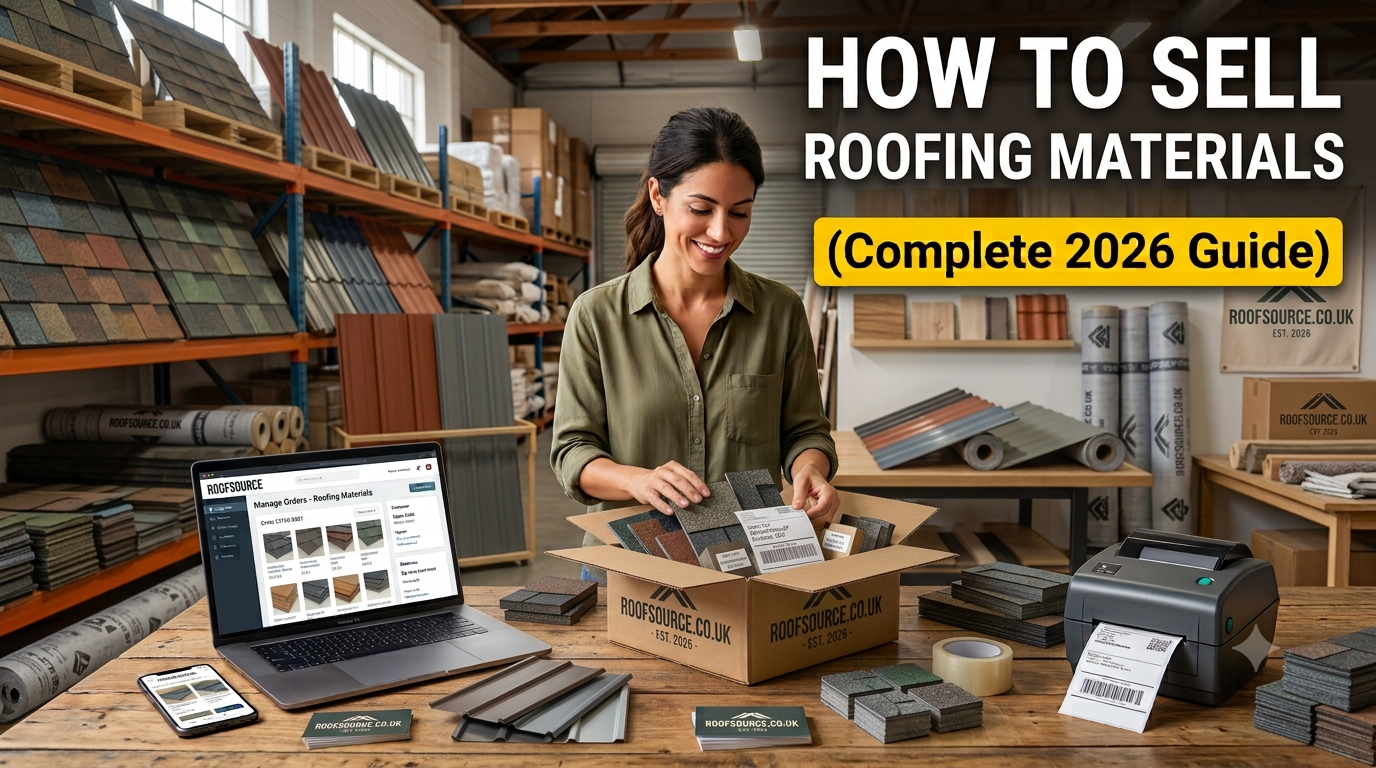
Selling roofing materials online can open up a much larger market for roofing suppliers, builders’ merchants and specialist roofing businesses.
Customers can now research roofing products, compare specifications and request materials online without having to visit a physical branch. For businesses that already sell roofing products locally, ecommerce can provide another way to reach homeowners, builders, roofers, contractors and property developers.
However, roofing is not a straightforward ecommerce category.
Customers aren’t simply buying a fixed product from a shelf. They may need materials based on roof area, dimensions, project requirements and wastage. Roofing products can also be heavy, bulky or difficult to ship.
In this guide, we’ll look at how to start selling roofing materials online, how to organise your product catalogue and how to make it easier for customers to work out what they need.
Is selling roofing materials online a good business?
Roofing is an established market serving both residential and commercial customers.
Potential customers include:
- Homeowners
- Roofers
- Builders
- Contractors
- Property developers
- Landlords
- Architects
- Building companies
- DIY customers
The products you sell can vary considerably depending on your target market.
A specialist roofing ecommerce store might sell everything from roofing tiles and sheets to insulation, membranes, fixings and installation accessories.
There is also significant potential for repeat trade business. A roofer who finds a reliable supplier may return regularly for future projects.
Decide what roofing products you’ll sell
The first step is deciding which part of the roofing market you want to serve.
Potential categories include:
- Roofing tiles
- Slate
- Roof sheets
- Metal roofing
- Corrugated roofing
- Flat roofing materials
- EPDM roofing
- Roofing membranes
- Felt
- Insulation
- Roof battens
- Fascia and soffits
- Guttering
- Flashing
- Roofing fixings
- Sealants and adhesives
- Roof windows
- Roofing accessories
You don’t necessarily need to stock everything.
A focused range can make it easier to establish expertise and target specific customers.
For example, a store specialising in metal roofing sheets can build its catalogue, content and marketing around that particular market rather than competing with every general building supplier.
Choosing an ecommerce platform
Your ecommerce platform needs to cope with more than a standard product catalogue.
When comparing platforms, consider:
- Product catalogue management
- Search engine optimisation
- Product filtering
- Product variations
- Payment options
- Delivery options
- Stock management
- Measurement-based pricing
- Trade pricing
- Long-term running costs
Roofing products can be particularly difficult to sell using a basic fixed-quantity product model because customers often need different amounts for every project.
WooCommerce can be a useful option when you need greater control over product configuration and pricing.
If you’re using WooCommerce, we’ve also published a dedicated guide covering how to price roofing materials according to area:
WooCommerce Roofing Calculator: How to Price Roofing Materials by Area (2026 Guide)
Build a clear roofing catalogue
Roofing products can have complicated specifications, so your catalogue needs to be easy to navigate.
Customers may want to filter products by:
- Material
- Brand
- Colour
- Profile
- Size
- Thickness
- Finish
- Application
- Roof type
- Indoor or outdoor use
Don’t make customers search through dozens of almost-identical products to find the one they need.
Good categorisation and filtering can make a major difference to the shopping experience.
Give customers detailed technical information
Roofing customers need more information than simply a product name and price.
Depending on the product, include details such as:
- Dimensions
- Coverage
- Material
- Thickness
- Weight
- Profile
- Colour
- Finish
- Application
- Installation requirements
- Warranty
- Fire performance
- Weather resistance
If a product has specific installation requirements, make those obvious.
A customer who understands the product before ordering is much less likely to need to contact your sales team or return an unsuitable product.
High-quality product photography matters
Roofing materials can be difficult to understand from a product name alone.
Use photography to show:
- Finished roofs
- Product close-ups
- Profiles
- Surface finishes
- Colour variations
- Installation examples
- Different roof types
For visually similar products, comparison images can be particularly useful.
The biggest challenge: calculating how much roofing material is needed
This is one of the most important problems to solve when selling roofing products online.
Customers may know the dimensions of their roof but not the amount of material required.
They may need to account for:
- Roof area
- Overlaps
- Cuts
- Wastage
- Roof pitch
- Product coverage
- Additional materials
If customers are expected to calculate everything manually, the buying process becomes much harder.
A customer may understand that their roof is a particular size but have no idea how that translates into the quantity of roofing material they need.
An online calculator can take the customer’s measurements and turn them into a useful estimate or price.
If you’re using WooCommerce, our guide WooCommerce Roofing Calculator: How to Price Roofing Materials by Area (2026 Guide) explains how to approach area-based pricing:
Don’t treat every roofing product the same
Different roofing materials have different calculation requirements.
For example, an area-based calculation may work well for some products, while others may depend on:
- Linear length
- Number of tiles
- Number of sheets
- Roof pitch
- Fixed pack sizes
- Overlap requirements
This is why simply putting a “quantity” field on a product isn’t always enough.
The ecommerce experience should reflect how the product is actually purchased and installed.
Make coverage information obvious
One of the most useful pieces of information you can provide is how much area a product actually covers.
For example, a product page might explain:
- Coverage per unit
- Coverage per pack
- Required overlap
- Recommended wastage
- Available dimensions
This allows customers to understand the relationship between the product they’re buying and the project they’re working on.
Sell roofing accessories alongside materials
Roofing projects often require many additional products.
Depending on your market, you could sell:
- Underlay
- Membranes
- Battens
- Fixings
- Nails
- Screws
- Flashing
- Sealants
- Adhesives
- Insulation
- Ridge products
- Ventilation
- Guttering
- Fascia
- Soffit
Cross-selling these products can increase order values while making your store more useful.
Project bundles can also make sense where customers regularly need the same combination of materials.
Shipping roofing materials
Roofing materials can create significant delivery challenges.
Products may be:
- Heavy
- Long
- Bulky
- Fragile
- Difficult to package
Before launching your online store, establish how you’ll handle:
- Pallet deliveries
- Long-length deliveries
- Local delivery
- Nationwide delivery
- Collection
- Delivery zones
- Minimum order values
- Delivery surcharges
Don’t underestimate shipping costs when setting product prices.
A product that looks profitable before delivery can become considerably less attractive once transport costs are included.
Local delivery can be a major advantage
You don’t necessarily need to compete nationally.
A local roofing supplier can use ecommerce to make ordering easier while retaining the advantages of a local business.
You could target searches such as:
- Roofing materials near me
- Roofing supplies
- Roofing supplies delivered
- Roofing merchant
- Roofing materials delivery
- Roof tiles near me
Fast local delivery and collection can be a compelling alternative to buying from a national supplier.
Build trust with professional customers
Roofing is an area where customers need to trust the supplier.
A roofer or builder doesn’t want to discover that a product specification was inaccurate after materials have arrived on site.
Make important information easy to find, including:
- Product specifications
- Availability
- Delivery times
- Manufacturer information
- Installation information
- Returns policy
- Warranty details
- Technical documentation
If you offer trade accounts, bulk pricing or repeat-order discounts, make those options visible as well.
Create useful roofing content
Roofing customers have a huge number of questions before they purchase.
That creates opportunities to attract search traffic through educational content.
Useful articles could include:
- How much roofing material do I need?
- How to measure a roof
- How much does a new roof cost?
- Roof tile buying guide
- Slate vs roof tiles
- Metal roofing vs traditional roofing
- How to calculate roof area
- How much roofing felt do I need?
- What roofing materials are best for an extension?
- How long do different roofing materials last?
This type of content can attract people while they’re researching a project and introduce them to your products before they’re ready to order.
Make quoting easier for larger projects
Not every roofing customer will be ready for a standard ecommerce checkout.
For larger projects, consider offering:
- Online quote requests
- Trade accounts
- Bulk pricing
- Customer-specific pricing
- Project enquiries
- Delivery estimates
You can combine self-service ecommerce for straightforward orders with human assistance for larger or more complicated projects.
That gives customers the convenience of online ordering without forcing every project into the same buying process.
Marketing your roofing business
Once your online store is ready, you’ll need to attract the right visitors.
Potential marketing channels include:
- Search engine optimisation
- Google Shopping
- Paid search
- Local SEO
- Email marketing
- Trade partnerships
- Social media
- Content marketing
SEO can be particularly effective because roofing searches are often highly specific.
Someone searching for a particular roofing material, size or application may already be close to purchasing.
Frequently asked questions
Can you make money selling roofing materials online?
Yes. Roofing materials can be sold to homeowners, roofers, builders, contractors and property developers. Profitability depends on product margins, delivery costs, competition and the type of customer you target.
How should roofing materials be sold online?
The answer depends on the product. Some roofing materials can be sold by area, while others may be sold by length, pack, sheet or individual unit. The important thing is to make the relationship between coverage, quantity and price clear.
How do customers calculate how much roofing material they need?
Customers can calculate the roof area from their measurements, but they may also need to account for overlaps, cuts, wastage and product coverage. A calculator can simplify this process by turning project dimensions into an estimated requirement or price.
Should I sell roofing materials by square metre?
Area-based pricing can be useful for products where the amount required relates directly to the surface being covered. However, the actual way the product is supplied should always be made clear to the customer.
Is WooCommerce suitable for selling roofing materials?
WooCommerce can be suitable for roofing businesses because it offers considerable flexibility around product pricing, variations and specialist ecommerce requirements. A calculator can be added when customers need to enter project measurements before purchasing.
Conclusion
Selling roofing materials online isn’t simply about creating a catalogue of products and adding a checkout.
Customers need accurate technical information, clear coverage details, reliable delivery options and a straightforward way to understand how much material their project requires.
The more complicated the product, the more important it becomes to remove unnecessary calculations and uncertainty from the buying process.
A successful roofing ecommerce business combines a well-organised catalogue with useful educational content, strong product information and an ordering process designed around how customers actually plan their projects.
If you use WooCommerce, our guide to WooCommerce Roofing Calculators explains how to handle area-based pricing and make it easier for customers to calculate the materials they need:
For roofing suppliers selling materials according to measurements, turning the customer’s project dimensions into a clear price can make the difference between a complicated enquiry and a straightforward online order.
Leave a Reply